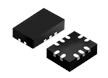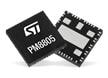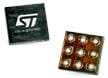

STEF05LAJR

STMicroelectronics
511-STEF05LAJR
STEF05LAJR

Fab. :

Description :
Contrôleurs de tension à remplacement à chaud Electronic fuse for 5 V line

Cycle de vie:
NRND:
Non recommandé pour de nouvelles conceptions.
Modèle de ECAO:
Téléchargez gratuitement le chargeur de bibliothèque pour convertir ce fichier pour votre outil ECAD. En savoir plus sur le modèle ECAD.

Disponibilité

Stock:
Non stocké
Minimum : 5000   Multiples : 5000
Prix unitaire:
-,-- €
Ext. Prix:
-,-- €
Tarif est.:
Ce produit est expédié GRATUITEMENT

Prix (EUR)

Qté. Prix unitaire
Ext. Prix
Bobine complète(s) (commandez en multiples de 5000)
0,459 € 2 295,00 €
0,438 € 4 380,00 €

Attribut de produit Valeur d'attribut Sélectionner l'attribut
STMicroelectronics
Catégorie du produit: Contrôleurs de tension à remplacement à chaud
RoHS:  
Reel
Marque: STMicroelectronics
Type de produit: Hot Swap Voltage Controllers
Série: STEF05L
Nombre de pièces de l'usine: 5000
Sous-catégorie: PMIC - Power Management ICs
Produits trouvés:
Pour consulter des produits similaires, sélectionnez au moins une case.
Sélectionnez au moins une case pour consulter des produits similaires dans cette catégorie.
Attributs sélectionnés: 0

CNHTS:
8542390000
CAHTS:
8542390000
USHTS:
8542390090
MXHTS:
8542399901
ECCN:
EAR99

LM5060 High-Side Protection Controllers

Texas Instruments LM5060 High-Side Protection Controllers with Low Quiescent Current offers intelligent control of a high-side N-channel MOSFET during normal on/off transitions and fault conditions. The constant rise time of the output voltage results from the inrush current control. Both an Input UVLO (with hysteresis) and a programmable input OVP are provided, with an enable input offering a remote on or off control. The initial start-up VGS fault detection delay time, the transition VDS fault detection delay time, and the continuous over-current VDS fault detection delay time is programmed from a single capacitor. The MOSFET is latched off until either the enable input, or the UVLO input is toggled low and then high when a detected fault condition persists longer than the allowed fault delay time.