




Texas Instruments Régulateur nano module SIMPLE SWITCHER® LMZ2050x
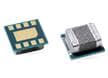
Les régulateurs nano-modules SIMPLE SWITCHER® LMZ2050x de Texas Instruments sont des convertisseurs abaisseurs synchrones faciles à utiliser et qui sont capables de piloter jusqu'à 2 A de charge à partir d'une alimentation de 5,5 V en entrée, avec une efficacité et une précision de sortie exceptionnelles dans une solution de taille très compacte. Leur boîtier innovant contient le régulateur et l'inducteur dans un volume réduit de 3,5 mm x 3,5 mm x 1,75 mm, économisant ainsi l'espace sur la carte et éliminant la durée et les dépenses liées à la sélection de l'inducteur. Le modèle LMZ2050x nécessite seulement cinq composants externes, et a été conçu pour offrir une disposition PCB simple et optimale.
Caractéristiques
- Integrated inductor
- Miniature 3.5mm × 3.5mm × 1.75mm package
- 1A (LMZ20501) or 2A (LMZ20502) maximum load current
- Input voltage range of 2.7V to 5.5V
- Adjustable output voltage range of 0.8V to 3.6V
- ±1% Feedback tolerance over temperature
- 2.4µA (max) Quiescent current in shutdown
- 3MHz Fixed PWM switching frequency
- -40°C to 125°C Junction temperature range
- Power good flag function
- Pin-selectable switching modes
- Internal compensation and soft-start
- Current limit, thermal shutdown, and UVLO protection
Applications
- Point of load regulation
- Space constrained applications
LMZ2050xEVM Eval Modules
Texas Instruments LMZ2050xEVM Evaluation Modules are capable of driving up to 2A load with excellent power conversion efficiency, output voltage accuracy, line and load regulation and load transient response. Each evaluation board is configured for 1.8V output voltage from 2.375V to 5.5V (LMZ20501EVM) or 2.7V to 5.5V (LMZ20502EVM) input, based on the resistor voltage divider RFBT and RFBB. Each board has a double sided six pin connector and turret terminals for easy connection and input supply, ground and load. The board features: three pin jumpers for EN, mode and frequency response analyses, power good monitoring when connected to a rail, inductor current sensing using a wire loop across the multilayer vias before the output capacitors, jumper option for mode pin to run the part on PFM or PWM at light load, frequency response jumper to measure the response across injection voltage resistor and the enable jumper to measure the quiescent current of the module.
Features Solutions
Texas Instruments Power Module Solutions
Comprehensive power module portfolio provides all-in-one, low cost power solutions.